
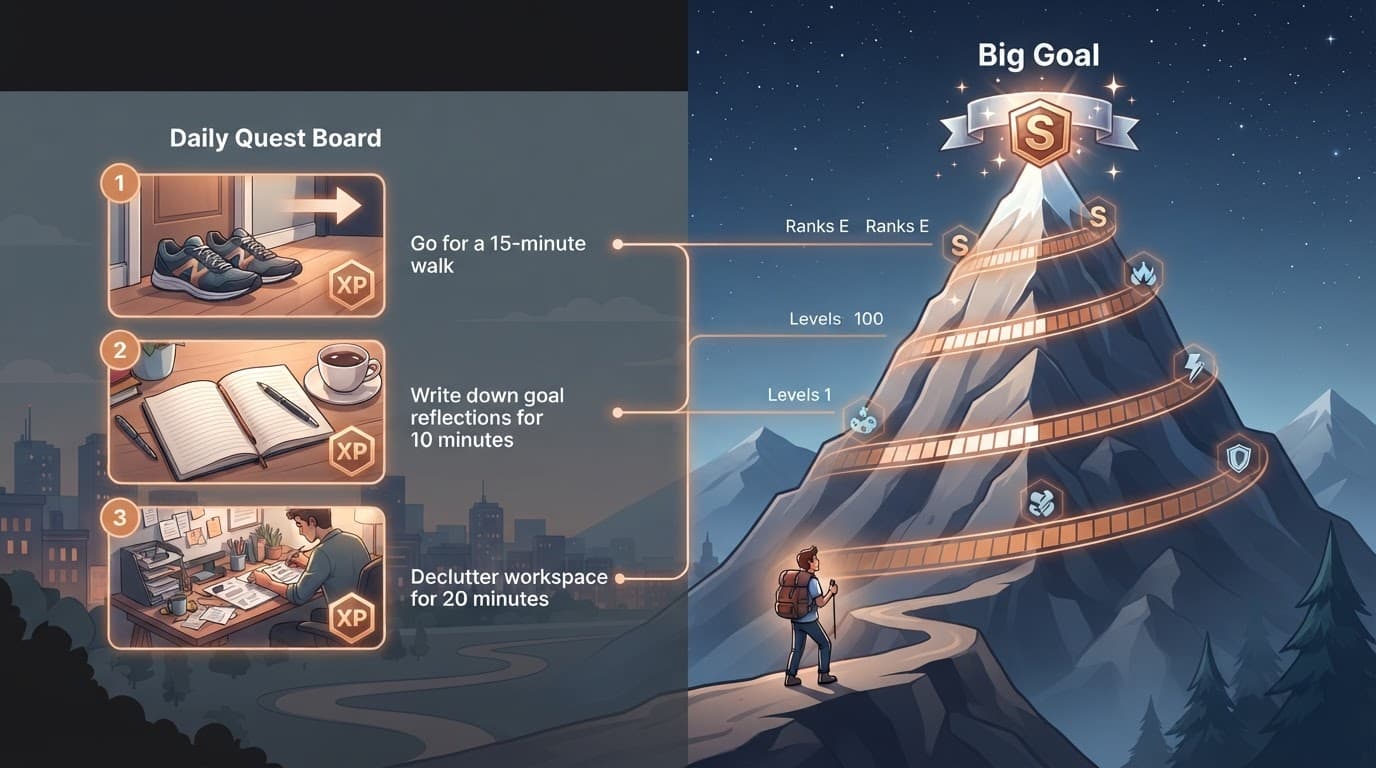
Most people set a big goal and then wait to feel ready before they start. They want the perfect plan, the perfect time, the perfect amount of motivation. And most of the time, that moment never comes.
Here is the honest answer: small daily actions are the most reliable path to big goals. Not because they feel exciting, but because they actually work. When you do something small and consistent every single day, that effort compounds. A 1% improvement each day adds up to nearly 37 times better over the course of a year. That is not motivational math; it is just how compounding works.
This post breaks down why small actions beat big leaps, what those actions should look like, and how to build a system that keeps you showing up even when motivation fades.
Why Big Goals Fail Without Small Actions
Think about the last big goal you set. Maybe it was getting fit, learning a language, writing a book, or saving money. You probably felt energized at the start. Then life happened, the goal felt enormous, and you stopped.
That is not a character flaw. It is a design problem.
Big goals, on their own, are overwhelming. They sit far away in the future and give you no clear instruction for today. So your brain, which naturally wants to conserve energy, finds reasons to delay.
Small daily actions solve this by answering one simple question: what should you do right now? Instead of "get fit," it becomes "walk for fifteen minutes after lunch." Instead of "write a book," it becomes "write two hundred words this morning." The action is clear, doable, and done before doubt has a chance to set in.
There is another reason small actions work better than occasional big efforts. Consistency beats intensity almost every time. Someone who reads ten pages every day will finish more books in a year than someone who reads a hundred pages once a month. Someone who does a short workout five days a week will be stronger in six months than someone who has occasional marathon gym sessions.
The goal is not to be dramatic. The goal is to be reliable.
What Small Daily Goals Actually Look Like
Small daily goals are not just big goals sliced into smaller pieces. They are actions that are:
- Specific enough to start immediately. "Exercise more" is not a small daily goal. "Do ten push-ups before breakfast" is.
- Completable within the day. If it takes a week to finish, it is a project, not a daily action.
- Tied to something you actually care about. Random tasks do not build momentum. Actions connected to a real goal do.
- Low enough in friction to survive a bad day. On your worst day, can you still do it? If yes, you have found the right size.
A practical example: someone who wants to become a better public speaker might have a small daily action like "record a one-minute voice memo explaining something you learned today." That takes three minutes total. It builds vocabulary, comfort with the sound of your own voice, and the habit of translating ideas into words. It connects directly to the bigger goal without being exhausting.
Another example: someone who wants to build more social confidence might commit to saying hello to one stranger each day. Not a long conversation, just a hello. Over time, that small action shifts how they see themselves and how they move through the world.
The size of the action matters less than the direction. Every small action should point at the goal, even loosely.
Six Daily Habits That Contribute to Success
When researchers and coaches look at people who consistently reach their goals, a few habits keep showing up. These are not magic rituals. They are simple practices that, done daily, create the conditions for progress.
1. Start with a clear intention for the day
Before the day fills up with other people's priorities, spend two or three minutes deciding what one thing matters most. Write it down. This is not about planning every hour. It is about giving the day a direction.
2. Move your body in some way
Physical movement improves mood, focus, and energy. It does not have to be a structured workout. A walk, a short bike ride, ten minutes of stretching; these count. The habit is motion, not performance.
3. Learn something deliberately
Reading, listening to a podcast that teaches something, watching a tutorial, or reflecting on a lesson from yesterday. Deliberate learning is different from passive consumption. The goal is to take in something useful and let it land.
4. Do the uncomfortable thing first
Every goal has a task that feels slightly uncomfortable. Making the call, starting the draft, sending the email. People who reach their goals tend to do that task early, before they have time to talk themselves out of it.
5. Track or note what you did
A short note at the end of the day about what you completed builds self-awareness and a sense of progress. It does not have to be elaborate. Even a one-line entry in a notebook creates a record that motivates you to keep the streak going.
6. Rest with intention
Progress requires recovery. Sleeping enough, stepping away from work, and allowing the mind to rest are not weaknesses. They are part of the system. People who skip rest tend to burn out and abandon their goals completely, which costs far more time than the rest would have.
Five Simple Steps to Reach Your Goal
There is a simple framework that helps people move from a vague ambition to a real plan. It is not complicated, but most people skip at least one step.
Step 1: Name the goal clearly
Write the goal in one sentence. Not "be healthier" but "run a 5K without stopping by the end of the year." The more specific the goal, the easier it is to identify what actions will move you toward it.
Step 2: Identify the daily action
Ask: what is the smallest thing I could do today that would move me toward this goal? That is your daily action. It should take less than thirty minutes, ideally less than fifteen, especially at the start.
Step 3: Remove the friction
Figure out what makes it easy to do and what makes it hard. If you want to exercise in the morning, lay your clothes out the night before. If you want to read before bed, put the book on your pillow. Reduce the number of decisions between you and the action.
Step 4: Build in a signal
Habits stick when they are attached to something that already happens. "After I pour my morning coffee, I will write for ten minutes" is more reliable than "I will write sometime today." The existing habit becomes a trigger for the new one.
Step 5: Review and adjust weekly
At the end of each week, spend five minutes looking back. Did you do the daily action? If not, why? Was it too big? Too vague? Did something keep getting in the way? Adjust accordingly. Small course corrections early prevent total derailment later.
This five-step process is not fancy, but it covers what most goal-setting advice skips: the gap between deciding and doing.
The 5-4-3-2-1 Goal Method (and What It Is Actually Good For)
Some readers come looking for the 5-4-3-2-1 method. It is worth explaining clearly because it gets mixed up with a few different ideas.
The version that is genuinely useful in this context is a countdown technique for beating hesitation. When you know what action you need to take but feel resistance, you count backward from five: 5, 4, 3, 2, 1, and then you move. No thinking, no negotiating with yourself. The countdown interrupts the mental spiral and turns intention into motion.
It sounds almost too simple. But the reason people do not take small daily actions is rarely ignorance. They know what they should do. The problem is starting. The countdown gives the brain a clear signal to switch from thinking to acting.
Combined with the five steps above, this technique becomes a useful tool for the daily friction of actually beginning.
How to Stay Consistent When It Gets Hard
Motivation is unreliable. It spikes when a goal is new and fades when the novelty wears off. Anyone who has kept a habit for more than a few weeks knows that most days, you will not feel like doing it. The people who keep going are not more motivated than everyone else. They have built systems that make it easier to continue than to quit.
Here are the approaches that hold up over time:
Make the bar low enough to survive your worst day. If your daily action requires your best self, it will disappear when your best self does not show up. Design for your average day, not your ideal one.
Focus on the streak, not the streak count. Missing one day is fine. Missing two in a row is the start of a new habit, and that habit is not doing the thing. One practical rule: never miss twice.
Use external accountability. Tell someone what you are doing. Check in with them. Having to report to another person, even briefly, raises the cost of quitting.
Connect the action to identity. Instead of "I am trying to run," say "I am a runner." Instead of "I am trying to write," say "I am a writer." Identity-based framing makes the daily action feel like an expression of who you are rather than a task you have to complete.
Celebrate small completions. Finishing a small action is worth acknowledging. Not with a party, but with a moment of recognition. "I did that." That small acknowledgment builds the internal reward signal that makes repetition more likely.
Making Progress Visible
One of the most underrated parts of reaching a big goal is being able to see that you are moving. Without visible progress, it is easy to feel like nothing is happening, even when it is.
Progress tracking does not have to be elaborate. A simple calendar where you mark each day you completed your action is one of the most effective tools available. Seeing a chain of completed days creates a psychological pull to keep the chain going.
Journaling is another form of making progress visible. Writing a few sentences about what you did and what you noticed builds a record that you can look back on. Three months from now, reading what you wrote at the start shows you how far you have come, which is often invisible in the day-to-day.
Some people find that tracking multiple dimensions of progress is useful. Rather than just counting days, they track the quality of what they did, how they felt, and what shifted. This kind of reflection turns a simple habit into something more meaningful.
The other value of visible progress is that it gives you data. If you notice that you always skip your daily action on Thursdays, that is useful information. Maybe Thursday has something that makes it harder. You can adjust.
A Tool That Turns This Into a Daily Practice
Understanding all of this is one thing. Actually doing something every day is another. That gap is where most people get stuck.
Solo Quest XP is an iPhone and iPad app built specifically for this problem. It is made for people who want to move a goal forward without turning it into an overwhelming project.
Here is how it works. Every day at 4:00 AM local time, the app delivers three small real-life quests. These are not digital tasks. They are things you go out and do in the world: starting a conversation with someone new, trying a food you have never eaten, going for a walk in an unfamiliar neighborhood, doing a physical challenge, reading something outside your usual topics. The quests are designed to be completable within a normal day.
You pick the one that fits today. You accept it, which starts a timer. You complete it in real life, then mark it done before the timer runs out. When you finish, you earn XP in one of six stats: Luck, Charisma, Strength, Stamina, Resilience, and Intelligence.
Those stats build over time. Your level rises from 1 to 100, and your rank climbs from E through S as your total XP grows. It is a simple RPG structure, and it works because progress becomes visible in a way that abstract goal-tracking usually is not.
The app also has an Adventure Log where you can save photos, videos, and notes from the quests you complete. That log becomes a record of real things you did, a visible trail of daily actions that add up.
For people who want to connect quests more directly to a personal goal, the Journal feature lets you write about what you want to accomplish and why it matters. With a Guild Pass, the Journal can suggest a quest tied to what you wrote. It is a way to go from a vague ambition to a specific action without having to figure out the translation yourself.
The app has more than 1,000 curated quests, so the daily board stays fresh for a long time. New users also get a seven-day Novice Protection period with unlimited free rerolls, which means you can swap out quests that do not fit until you get a feel for the system.
What makes this relevant to everything covered in this post is that it solves the hardest part of small daily actions: deciding what to do. Every day you open the app and your action is already there. You just have to choose and go.
You can learn more about how it works on the about page, or download it directly from the App Store.
Pulling It Together
Big goals are not reached in one heroic effort. They are reached through hundreds of small, ordinary actions done consistently over time. That is not a consolation prize for people who lack ambition. It is actually the more powerful path.
The math is simple even if the practice is not. A small action done daily for a year outperforms a large action done occasionally in almost every domain. Fitness, learning, relationships, creativity, financial habits; all of them respond to consistency more than intensity.
The practical question is always the same: what is the one small thing you can do today that points toward where you want to go? Find that thing. Do it. Come back tomorrow and do something like it again.
That is the whole system. Everything else is just finding ways to make it easier to stick with.
If you want a structure that removes the daily decision-making and makes your progress genuinely visible, Solo Quest XP is worth trying. It hands you a real-life action every day and keeps score in a way that makes the accumulation of small efforts feel like something.
Start the streak. Keep it going. The big goal is closer than it looks when you are moving toward it every day.