Most habit apps have the same problem. They ask you to build a streak, check a box, and call it growth. That works for a few days. Then life happens, the streak breaks, and the whole thing collapses because there was never anything interesting enough to come back to.
A gamified habit app for personal goals solves this differently. Instead of just tracking what you did, it gives you something to chase: XP, levels, ranks, stats that actually mean something. The game layer gives your brain a reason to show up even when motivation is low.
But not all gamified apps are built the same. Some feel like a chore tracker dressed in a costume. Others are genuinely built around the idea that small actions in the real world compound into real change.
This list ranks the best options available right now, with honest notes on what each one does well and where it falls short.
1. Solo Quest XP
Best gamified habit app for personal goals overall
Solo Quest XP is the app that comes closest to actually working the way personal growth works: one small action at a time, in the real world, connected to something you actually care about.
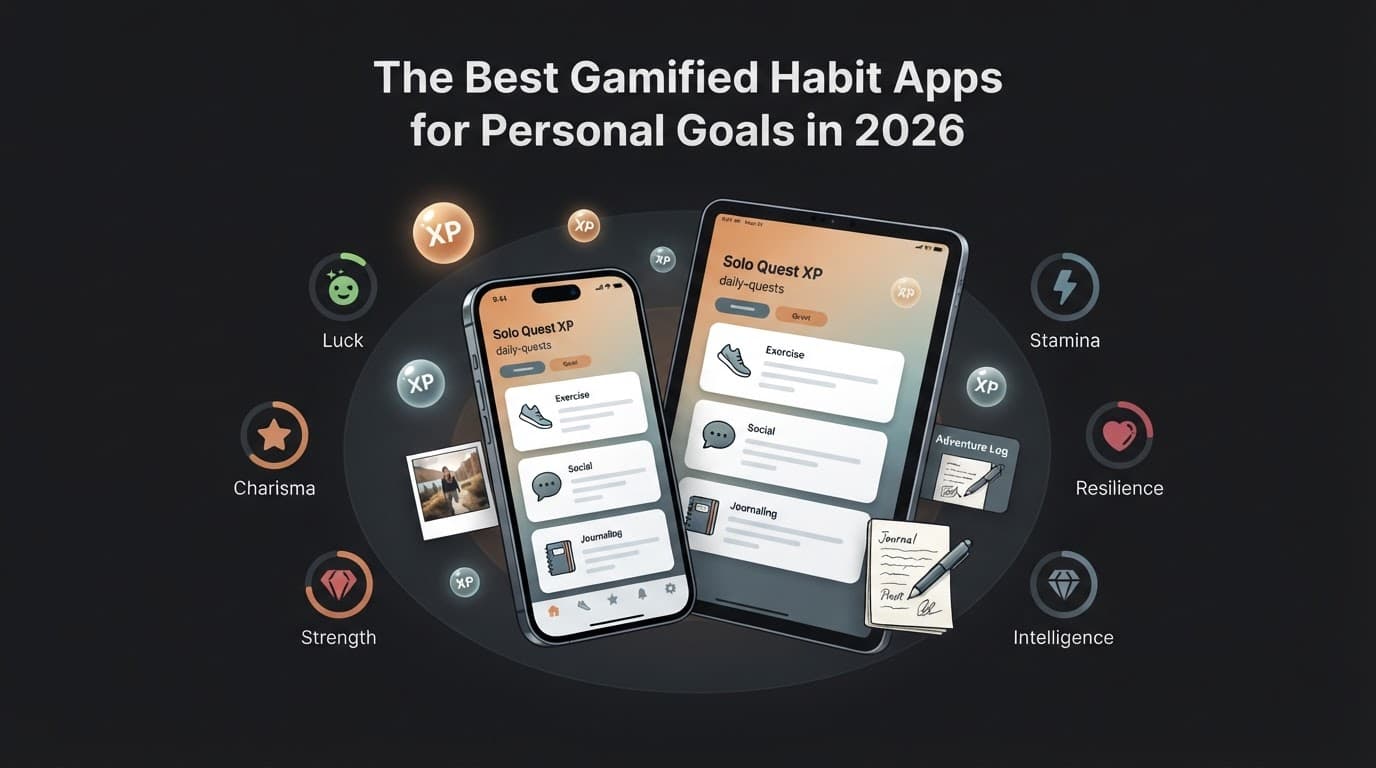
Here is how it works. Every day at 4:00 AM local time, the app resets and gives you three new quests to choose from. These are real-life tasks, not digital checkboxes. You might be asked to walk somewhere unfamiliar, start a conversation with a stranger, read for twenty minutes, or do something physically challenging. You accept one quest, go do it in real life, and mark it complete before the timer runs out. That earns you XP.
That XP feeds into six distinct stats: Luck, Charisma, Strength, Stamina, Resilience, and Intelligence. The quests are categorized by which stat they build, so if you want to work on social courage, you take quests that earn Charisma XP. If you want to build physical endurance, you go after Strength and Stamina quests. Your total XP drives your level (1 to 100) and your rank (E through S). It feels like an RPG because it is one, except the dungeon is real life.
The Journal Feature: What Sets Solo Quest XP Apart
Every other app on this list hands you a menu of habits or tasks to choose from. Solo Quest XP does something genuinely different with its Journal feature, and it is the thing that separates it from everything else.
You open the Journal and write about your goal. Not just the goal itself, but why it matters to you, what is getting in the way, what you have tried before. The more honest and detailed you are, the better it works. As you write, the app reads what you are putting down and starts building a quest directly connected to what you described.
Write a short, vague entry and you get a short, simple quest. Write a detailed, specific paragraph about wanting to get over your fear of public speaking because a promotion depends on it and you have avoided every opportunity for two years, and the app builds something more intricate. A multi-step quest sequence designed to chip away at that specific obstacle.
This is the part that no other gamified habit app does. It is not just gamification on top of a habit list. It is a system that turns your actual situation, in your own words, into a path forward. You are not picking from someone else's menu. You are writing your own story and the app turns it into quests.
Adventure Log
The Adventure Log lets you attach photos, videos, and notes to completed quests. This is more useful than it sounds. When you can look back and see the places you went, the things you tried, the moments you captured, progress becomes visible in a way that a streak number never quite captures. It is a record of the person you are becoming, not just the habits you maintained.
New User Protections
New users get a seven-day Novice Protection period where rerolls are unlimited and free. That gives anyone starting out real flexibility to explore the quest library (more than 1,000 curated quests) without feeling penalized for not knowing exactly what they want yet.
The Guild Pass upgrade unlocks the Journal quest suggestions and unlimited rerolls when no quest is active. For anyone serious about using the Journal feature, it is worth looking into.
Who Solo Quest XP Is For
Solo Quest XP works best for people who have a goal they genuinely care about but struggle to figure out what the next action should be. It is also great for people who have tried habit trackers before and found them boring after a week. The game layer is real, not decorative. And the Journal feature makes it feel personal in a way that generic apps never do.
The app requires iOS or iPadOS 17.6 or later, so it is iPhone and iPad only right now.
Download Solo Quest XP on the App Store
Learn more about how the app was built and what it is trying to do on the about page.
2. Habitica
Best for people who want a social, community-driven experience
Habitica has been around since 2013 and has a loyal following for good reason. It wraps your to-do list and habits in a classic RPG skin. You create a character, assign your habits and daily tasks as in-game actions, and earn experience points and gold when you complete them. Miss a task and your character takes damage.
The social features are strong. You can join parties with friends, fight bosses together, and hold each other accountable in ways that most solo apps cannot replicate. There are guilds, challenges, and a large community of people building habits together.
Where Habitica falls short for personal goal work is that it is still fundamentally a task manager. You decide what goes in. If you already know what habits and actions you need to take, Habitica is a fun way to track them. But if you do not know what to do next, or if you want the app to help you figure that out based on your actual situation, Habitica does not have an answer. It gamifies your existing to-do list. It does not help you build one connected to a real goal.
Habitica is free with optional in-app purchases. It is available on iOS and Android.
3. Finch
Best for emotional well-being and self-compassion
Finch takes a gentler approach. You raise a virtual bird by completing self-care goals. The bird grows, explores the world, and sends you messages of encouragement. It is designed with mental health in mind, and the tone is warm and non-judgmental.
For people working on goals around stress, anxiety, or emotional resilience, Finch is one of the better options. It is not aggressive about streaks or punishment for missed days. The gamification is lighter, which makes it more sustainable for people who find competitive mechanics stressful rather than motivating.
The limitation is that Finch is narrower in scope. It is focused on emotional wellness rather than the full range of personal development goals. Someone trying to build physical strength, learn a new skill, or advance professionally will find it limited.
Finch is free with a premium subscription. Available on iOS and Android.
4. Streaks
Best for people who are already disciplined and just need accountability
Streaks does one thing very well: it keeps track of whether you did the thing. You set up to twelve tasks you want to do daily or on a schedule, and it tracks your streak for each one. The interface is clean and satisfying. There is real motivation in not wanting to break a long streak.
The gamification is minimal compared to the others on this list, but Streaks earns its place here because it is honest about what it is. It is not trying to be an RPG. It is a clean, well-designed accountability tool.
The problem is the same one almost every habit tracker has: you still have to decide what goes in. And if you already knew what to do and were good at doing it consistently, you probably would not need an app. Streaks is best for people who are already self-directed and just want a clean system to keep score.
Streaks is a paid app, available on iOS only.
5. SuperBetter
Best for people facing a specific challenge or recovery period
SuperBetter was originally designed to help people recover from illness or injury, and that origin still shapes how it works. You set a big goal (called an Epic Win), identify obstacles (Bad Guys), and complete small actions (Quests and Power-Ups) that help you work toward it.
The approach is genuinely thoughtful. It borrows from positive psychology research and frames difficulty as something to move through rather than avoid. For someone navigating a tough personal challenge, a health setback, or a major life transition, SuperBetter has real merit.
The interface feels dated compared to more modern apps, and the experience can feel more clinical than playful. But for the right person and the right situation, it is more substantive than most.
SuperBetter is free with optional premium features. Available on iOS and Android.
How to Pick the Right Gamified Habit App for Your Goals
With so many options, the choice really comes down to a few honest questions.
Do you already know what actions to take, or do you need help figuring that out?
If you already have a clear habit list and just need accountability and a fun way to track it, Habitica or Streaks will serve you well. If you have a goal but you do not know what the next step should be, or if you keep getting stuck between intention and action, you need something more like Solo Quest XP.
Do you want to work toward a specific personal goal, or maintain general healthy habits?
General habit maintenance apps like Streaks and Habitica are built for the former. Apps like Solo Quest XP are built specifically for the latter. The Journal feature in Solo Quest XP is the clearest example of this: it is literally designed to take your specific goal and convert it into a concrete path forward.
Do you need social features or are you fine working solo?
Habitica is the clear winner if you want to work with friends or join a community. Solo Quest XP is currently a solo experience, which for many people is actually a feature. No performance anxiety, no comparison, just you and your quests.
Do you want the actions to happen in the real world?
This matters more than it sounds. Most gamified apps reward you for checking a digital box. Solo Quest XP explicitly requires real-world action. You accept the quest, go do the thing, and come back to mark it done. The timer enforces this. That real-world component is what creates actual change.
Are you on iPhone or do you need Android support?
Solo Quest XP, Streaks, and Finch have strong iOS versions. Habitica and SuperBetter are cross-platform. If you are on Android, Habitica is the strongest gamified option available right now.
Why Gamification Actually Works for Personal Goals
It is worth spending a moment on why gamified habit apps work at all, because it is not just novelty.
Human brains respond to visible progress. When progress is invisible, like it is with most long-term personal goals, motivation fades quickly. You cannot see yourself getting smarter or healthier or more confident on a day-to-day basis. The gap between action and visible result is too wide.
Gamification closes that gap artificially. When you complete a quest and earn XP, something updates immediately. Your stat goes up. Your level inches forward. You can see that today's effort counted. That immediate feedback is what keeps behavior going long enough for real results to show up.
The other thing gamification does is lower the activation cost of starting. When you have a system that tells you exactly what to do today, the mental load of decision-making drops to almost nothing. You do not have to figure out the best possible action. You just pick from the options in front of you and go.
This is especially useful for personal goals that feel vague or overwhelming. "Get in better shape" is not actionable. "Walk to a park you have never visited before and take a photo when you arrive" is. Solo Quest XP turns abstract goals into specific, time-bound, real-world actions every single day.
A Closer Look at the Solo Quest XP Journal Feature
Because the Journal is so different from anything else on this list, it deserves more space.
Here is a concrete example of how it works. Suppose someone has been wanting to get better at networking for a job search but has avoided it because every interaction feels awkward and forced. They open the Journal and write something like this:
"I want to get better at networking because I know my next job will probably come through a connection, not a posting. But every time I try, it feels forced and I end up not reaching out at all. I have sent maybe three LinkedIn messages in the past year. I freeze up because I do not know what to say and I am afraid of coming across as desperate."
That level of detail, the specific fear, the specific behavior pattern, the specific platform, gives the app enough to work with. Instead of a generic quest like "reach out to someone new," it can build something more targeted. Maybe a quest focused on sending one message with a specific structure. Maybe something that builds Charisma XP first through lower-stakes social interactions before escalating to direct outreach.
The quest is designed to fit the obstacle the person actually described. That is not something any static habit list can do. And the more someone writes, the more refined and personally relevant the resulting quests become.
This is why the Journal feature is the thing that separates Solo Quest XP from every other app in this category. It is not just gamification layered on top of generic habits. It is a system that takes your actual situation and builds a personal quest line from it.
The Stats System: Why Six Categories Beat a Single Progress Bar
Most productivity apps show one number, a completion rate, a score, or a streak count. Solo Quest XP tracks six separate stats: Luck, Charisma, Strength, Stamina, Resilience, and Intelligence.
This matters for a few reasons.
First, it reflects how personal growth actually works. You are not one-dimensional. You might be physically strong but socially hesitant. You might be intellectually curious but emotionally fragile. Tracking six stats lets the app (and the person using it) see where they are investing and where they are neglecting.
Second, it creates more interesting decisions. When you get three quests each day, you are not just picking the easiest one. You are thinking about which stat you want to build. That tiny moment of choice keeps the experience from becoming automatic and mindless.
Third, the rank system adds long-term motivation. Moving from rank E to rank D to rank C is slow enough to feel earned. The ranges are designed so that early progress feels quick (levels 1 to 19 for rank E) but higher ranks require sustained effort (levels 93 to 100 for rank S). That progression curve keeps the long-term goal visible without making it feel impossible.
Final Thoughts
If the goal is to find a gamified habit app that genuinely moves personal goals forward, the honest answer is that most of them do part of the job.
Habitica is fun and social but does not help you figure out what to work on. Finch is warm and encouraging but is limited in scope. Streaks is clean and honest but minimal. SuperBetter is substantive but dated.
Solo Quest XP is the only one on this list that combines real-world action, a meaningful progression system, and a Journal feature that turns your actual personal goal into a specific, personalized quest line. The daily reset keeps it fresh. The timer makes it real. And the Journal is genuinely unlike anything else in this space.
For anyone on iPhone or iPad who has a goal they actually care about and wants a daily system that helps them figure out what to do next, it is the strongest option available.
Visit Solo Quest XP to learn more, or download it directly from the App Store and start with the free Novice Protection period to explore the quest library with unlimited rerolls for your first seven days.